
How Does J M Jacquard’s Loom Mechanism Work?
If you’ve ever struggled with creating intricate textile patterns by hand, you’re not alone. Many people find it time-consuming and frustrating to get consistent designs without endless trial and error. That’s where understanding Jacquard’s loom can make a big difference.
J M Jacquard’s loom works by using punched cards to control which warp threads lift, creating complex patterns automatically. You feed a sequence of cards with holes representing thread positions; hooks and needles respond by raising the correct threads in sync.
This automation replaces manual pattern setting, making design repetition and variation simple.
It also paved the way for programmable machines. Keep exploring, and you’ll uncover how this innovation shaped textiles and modern computing.
Key Takeaways
- Jacquard’s loom uses punched cards with holes to control which warp threads lift, automating complex pattern weaving.
- Each punched card represents a row of the pattern, directing hooks to raise specific warp threads accordingly.
- Needles aligned with punched cards detect holes, triggering hooks to lift corresponding threads for pattern formation.
- The sequence of punched cards can be changed to produce different intricate fabric designs without manual reconfiguration.
- Proper thread tension and regular maintenance ensure accurate, smooth operation and precise pattern reproduction.
Why Jacquard’s Loom Matters

Although it was invented over two centuries ago, Jacquard’s loom still shapes how textiles are made today. You might not realize it, but this invention transformed textile innovation by automating complex patterns that once required skilled handweaving.
Its historical impact goes beyond just fabrics. It laid the groundwork for programmable machines, influencing computing technology. When you think about weaving, Jacquard’s loom introduced a method that uses punched cards to control the weave, allowing intricate designs to be replicated quickly and accurately.
This not only boosted production efficiency but also expanded creative possibilities in textile design. By understanding why Jacquard’s loom matters, you appreciate how it changed an entire industry and inspired future innovations.
What Is Jacquard’s Loom?

How exactly does Jacquard’s loom work? At its core, Jacquard’s loom is a groundbreaking textile innovation that transformed fabric production by automating complex patterns. You’re looking at a device that uses a series of punched cards to control the lifting of warp threads, allowing intricate designs without manual intervention.
This method marked a significant leap in mechanical engineering, applying programmable logic to weaving. Instead of relying on skilled weavers to manipulate each thread, Jacquard’s loom translates pattern instructions directly from the punched cards to the loom’s hooks and needles.
This system not only speeds up production but also ensures consistent quality and detail in textiles. When you consider its impact, you see how this invention bridged traditional craftsmanship and industrial automation, setting the stage for modern programmable machines.
Warp and Weft Threads in Jacquard’s Loom
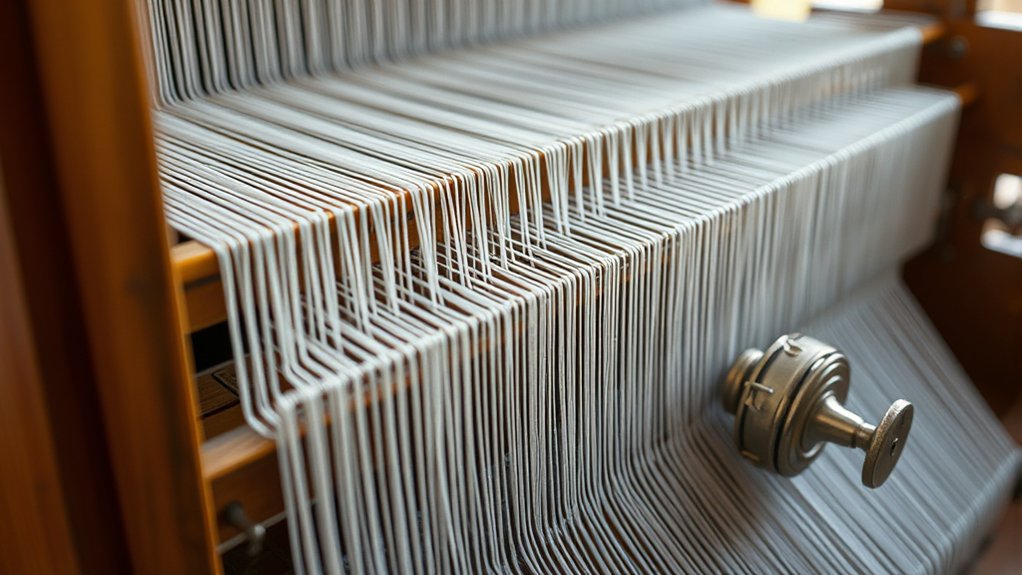
You’ll notice the warp threads run lengthwise—they form the backbone of the fabric. Then, the weft threads weave crosswise, weaving in and out of the warp to bring the pattern to life. When you get how these threads work together, it’s easier to see how Jacquard’s loom creates those intricate designs.
Warp Thread Functionality
When you examine Jacquard’s loom, you’ll notice the warp threads play an essential role in forming the fabric’s foundation. These vertical threads remain under consistent fiber tension, which is fundamental to keeping the fabric even and preventing distortion.
You need to monitor this tension carefully during loom maintenance to avoid breaks or slack that could disrupt the weaving process. Each warp thread passes through the heddles and responds individually to the loom’s punched cards, lifting or lowering to create the pattern.
Weft Thread Integration
Where do the weft threads fit into Jacquard’s intricate weaving process? They’re essential for creating the fabric’s crosswise structure, woven horizontally through the vertical warp threads.
As you guide the weft thread back and forth, maintaining consistent thread tension is vital. Uneven tension can distort the pattern and weaken the fabric.
The loom’s mechanism lifts specific warp threads in sequence, allowing the weft to pass precisely where needed. You must regularly perform loom maintenance to guarantee the shuttle moves smoothly and the heddles raise correctly.
Proper upkeep keeps thread tension steady and prevents snags or breaks. By integrating the weft threads skillfully, you achieve the complex, detailed designs Jacquard’s loom is famous for, blending mechanical precision with textile artistry.
How Jacquard’s Punched Cards Translate Designs
Although the Jacquard loom looks complex, its punched cards make translating designs straightforward. Each card represents a row of the pattern, with holes indicating which threads to lift. As you feed these cards into the loom, they control the hooks that raise specific warp threads, creating the desired design.
The Jacquard loom uses punched cards to effortlessly translate designs by controlling which threads are lifted row by row.
This method marked a huge technological innovation, allowing intricate patterns to be woven automatically. It was a major step forward from manual weaving.
The historical significance of these punched cards goes beyond textiles. They inspired early computer programming by introducing a way to store and execute instructions mechanically. Here’s how the cards work in practice:
- Holes in the card correspond to raised threads, shaping the pattern.
- The sequence of cards dictates the pattern’s full repeat.
- Cards can be rearranged or replaced to create different designs.
You’ll see how this clever system turned complex weaving into a programmable process, transforming textile production forever.
How Hooks and Needles Work Together to Weave Patterns
Because the punched cards control which hooks engage, you’ll find that these hooks play an essential role in lifting specific warp threads. When a card’s hole corresponds to a hook, that hook is raised, pulling its attached warp thread upward.
The needles align precisely with these hooks, ensuring that only the intended threads lift to create the pattern. You need to maintain proper needle alignment so that each hook responds accurately to the punched cards. If needles are misaligned, the pattern may distort or skip.
Thread tension also plays a critical role here. If tension is uneven, the hooks might not lift threads smoothly, affecting the fabric’s consistency. By carefully balancing thread tension and ensuring accurate needle alignment, the hooks and needles work in unison to weave detailed and consistent patterns.
This delicate interaction transforms the punched card instructions into tangible designs on the fabric you see.
How Jacquard’s Loom Automates Complex Patterns
You’ll see how Jacquard’s loom uses punch cards to control intricate weaving patterns automatically. This system selects specific warp threads without manual effort, making complex designs possible.
Punch Card Pattern Control
When you look closely at Jacquard’s loom, you’ll notice that punch cards play a crucial role in automating intricate patterns. These cards control which hooks lift warp threads, allowing complex designs without manual adjustments. Each card corresponds to one row of the pattern, and the punched holes dictate thread movement.
To keep the loom running smoothly, pay attention to maintaining proper thread tension to avoid fabric defects. Regular loom maintenance is important to guarantee punch cards feed correctly. Also, aligning punch cards precisely can help prevent pattern errors.
Automated Warp Thread Selection
Although the Jacquard loom looks complex, it automates warp thread selection by using a series of hooks connected to the punch cards. Each hook corresponds to a warp thread, and when a punched hole allows a hook to lift, the associated thread raises, creating the pattern.
You don’t need to manually pick threads, which speeds up weaving intricate designs. Managing thread tension is vital because consistent tension ensures threads lift smoothly without breaking or snagging.
Regular loom maintenance keeps hooks and needles aligned, preventing jams and preserving the accuracy of thread selection. By automating this process, you can produce complex patterns efficiently while reducing errors linked to manual operation.
The genius of Jacquard’s mechanism lies in this precise, automated control of each warp thread.
Why Jacquard’s Loom Changed Textile Production
Why did Jacquard’s loom transform textile production? You can thank its innovative mechanism for making complex patterns easier and faster to weave. Before Jacquard’s invention, creating intricate designs with textile dyes required manual labor, which was slow and prone to errors.
The loom’s automated thread selection not only sped up production but also reduced mistakes, allowing you to produce vibrant, detailed fabrics consistently.
With Jacquard’s loom, you’ll notice these game-changing benefits:
- Simplified loom maintenance due to fewer manual adjustments
- Increased efficiency in weaving complex patterns
- Improved precision in applying textile dyes for detailed designs
How Jacquard’s Loom Influenced Early Computing
You can see how Jacquard’s loom introduced programmable pattern control by using punched cards to guide weaving sequences. Basically, it used holes and no holes to represent information—kind of like early binary code. This approach made it possible to automate complex designs without manual intervention.
When you understand how this system worked, it’s easier to see the connection to early computing technologies. After all, those punched cards laid the groundwork for how computers would later process data in a similar on-or-off way. So, Jacquard’s invention was more than just a weaving tool; it was a key step toward modern computing.
Programmable Pattern Control
Because it uses punched cards to control weaving patterns, Jacquard’s loom introduced a form of programmable pattern control that laid the groundwork for early computing. You can see how this technique transformed textile innovation by allowing intricate designs to be automated rather than manually crafted. This leap directly influenced the pattern evolution in fabric production, making complex motifs easier and faster to produce.
When you engage with Jacquard’s system, you realize it offered repeatability: the same pattern could be woven precisely every time. It also brought flexibility, since changing patterns was as simple as swapping punched cards. Plus, automation reduced manual labor while increasing design complexity.
This programmable control concept inspired early computing pioneers to think about how machines could process instructions, marking a key step in technology’s evolution.
Binary Data Representation
Although Jacquard’s loom was designed for weaving, its use of punched cards introduced a form of binary data representation that early computing pioneers quickly recognized. This historical significance lies in how the loom’s mechanism encoded patterns as sequences of holes, essentially ones and zeros.
This approach paved the way for technological innovation in data processing. You can see how this concept inspired early computers to use binary codes for instructions and data storage.
| Aspect | Jacquard’s Loom | Early Computers |
|---|---|---|
| Data Format | Punched Cards (holes/no holes) | Binary Code (0s and 1s) |
| Function | Pattern control | Instruction execution |
| Flexibility | Programmable designs | Programmable software |
| Automation | Automated weaving | Automated computing |
| Legacy | Textile innovation | Computing foundation |
Jacquard’s loom truly bridged textile art and the digital paradigm shift.
How to Recognize Patterns Made by Jacquard Looms
When examining fabric patterns, you’ll notice that Jacquard looms create intricate designs with remarkable precision. These patterns stand out because of their detailed tapestry weaving, where each thread is controlled individually. This control allows for complex color patterning that’s hard to replicate with simpler looms.
Jacquard looms craft intricate, precise designs by individually controlling each thread for complex, detailed patterns.
To recognize patterns made by Jacquard looms, pay attention to:
- Complexity: The designs often feature detailed images or motifs with fine lines and curves.
- Color Variation: Look for multiple colors woven seamlessly into the fabric, creating vivid, multi-dimensional effects.
- Tight Weave: The fabric usually has a tight, consistent weave, showing no signs of irregularities or loose threads.
How Modern Textile Machines Use Jacquard’s Principles
How exactly do modern textile machines build on Jacquard’s transformative principles? You’ll find that today’s advanced looms still rely on the core idea of controlling individual threads to create complex patterns. While Jacquard used punched cards to automate weaving, modern machines employ digital systems that offer greater speed and flexibility.
This evolution marks a significant milestone in textile innovation, allowing you to produce intricate designs with precision and minimal manual intervention.
You should also appreciate the historical significance of Jacquard’s mechanism. It laid the groundwork for programmable automation, influencing not just textiles but computing itself. When you operate or study modern textile equipment, you’re interacting with technology deeply rooted in Jacquard’s concept of pattern control.
Frequently Asked Questions
Who Invented the Punch Card Concept Before Jacquard?
You should know that the punch card concept was first developed by Basile Bouchon in the early 18th century, long before Jacquard. Bouchon used punched paper strips to control early textile machinery, marking a key moment in punch card evolution.
This system allowed automated pattern control, which Jacquard later improved upon with his loom. So, if you’re exploring punch card history, Bouchon’s work is a vital starting point.
What Materials Are Best for Making Jacquard Loom Punch Cards?
For fantastic fiber selection, you’ll want sturdy stock like thick cardstock or tough tagboard to guarantee punch card durability. These materials withstand repeated handling and mechanical movement without tearing or warping.
Some even opt for coated or laminated paper to prolong life. Avoid flimsy fibers; they fray fast and fail frequently.
How Long Does It Take to Set up a Design on Jacquard’s Loom?
Setting up a design on Jacquard’s loom can take several hours to a full day, depending on complexity. You’ll need to carefully adjust thread tension to guarantee consistent weaving, which directly affects loom efficiency.
If the tension’s off, your fabric might warp or the machine could jam, slowing you down. So, patience during setup pays off by boosting efficiency and producing high-quality patterns without constant stops or rework.
Are There Any Famous Artworks Created Using Jacquard Looms?
You’ll find famous artworks woven like stories in fabric, where textile innovation breathes life into threads. Jacquard looms transformed artistic techniques, letting creators paint with yarn instead of brushes.
Tapestries from the 19th century, such as those inspired by historical scenes or nature, showcase this blend of craft and art. When you delve into these woven masterpieces, you see how technology and creativity dance together, turning cloth into timeless visual poetry.
What Maintenance Is Required for a Jacquard Loom?
You need to regularly perform loom calibration to ensure precise weaving patterns and prevent errors. Checking the punch card durability is vital since worn or damaged cards can cause misreads and fabric defects.
Clean the loom parts to avoid dust buildup, lubricate moving components, and inspect mechanical linkages for wear. Staying on top of these maintenance tasks keeps your Jacquard loom running smoothly and produces high-quality textiles consistently.
Conclusion
You might think Jacquard’s loom is just an old weaving tool, but it’s much more. It transformed how patterns are created and paved the way for modern computing.
By using punched cards to control hooks and needles, it made complex designs possible and efficient. So even if it seems outdated, its principles still power today’s textile machines.
This proves that innovation from the past can shape the future in surprising ways, especially through Jacquard’s loom mechanism.