How to Understand the Jacquard Loom Invention
If you’ve ever tried to create intricate fabric patterns by hand, you know how time-consuming and challenging it can be. You’re not alone—many people struggle with the painstaking process of weaving detailed designs manually. That’s why understanding the Jacquard loom invention is so important; it revolutionized how complex patterns are made.
To understand the Jacquard loom invention, you’ll see how it automated weaving by using punch cards that control complex fabric patterns. This replaced manual work with precise, programmable mechanical steps, boosting efficiency and creativity in textile production.
The loom’s innovation not only transformed fabric design but also laid the groundwork for early computing and automation.
Investigate how this breakthrough merged craftsmanship with technology and sparked a lasting impact beyond textiles.
Key Takeaways
- The Jacquard loom automated complex weaving by using punch cards to control patterns precisely and repeatedly.
- Joseph Marie Jacquard combined mechanical engineering with weaving knowledge to create a programmable loom.
- Punch cards encode thread movement instructions, enabling intricate designs without manual intervention.
- The invention improved textile production efficiency, quality, and artistic possibilities through automation.
- Despite initial mechanical challenges, the loom laid the foundation for programmable machines and modern automation.
What Is the Jacquard Loom and Why It Matters

What makes the Jacquard loom so important? It transformed textile innovation by automating complex patterns in fabric production, a breakthrough in mechanical engineering. You’ll see that before its invention, weaving intricate designs demanded painstaking manual effort, limiting creativity and efficiency.
The Jacquard loom uses a system of punched cards to control the weaving process, allowing you to produce detailed patterns with precision and speed. This automation didn’t just speed up production; it changed the textile industry by enabling mass production of high-quality fabrics that were previously too time-consuming to create.
When you understand the loom’s mechanism, you appreciate how it laid the groundwork for later developments in programmable machines. It’s a prime example of how mechanical engineering can directly impact an industry, pushing boundaries and opening new possibilities.
Who Was Joseph Marie Jacquard: And How He Invented the Loom

You’ll want to learn about Joseph Marie Jacquard’s early life because it really shaped how he worked. When you understand the steps he took to invent the loom, it makes you appreciate its impact even more. So, let’s take a closer look at how his ideas turned into this groundbreaking machine.
Jacquard’s Early Life
Although Joseph Marie Jacquard grew up in a modest family, his curiosity and mechanical skill set him apart from an early age. You’d find his interest deeply rooted in fiber art, a key part of weaving history that shaped his path.
From childhood, Jacquard closely observed how fabrics were crafted, sparking ideas about improving the weaving process. Growing up in a region known for textile production, he didn’t just accept tradition. He questioned it.
His hands-on experience with looms and tools helped you understand how innovation could transform the industry. By combining his natural talent with practical knowledge, Jacquard laid the groundwork for what would become a groundbreaking invention.
His early life shows that even humble beginnings can lead to transformative contributions in fiber art and weaving history.
Loom Invention Process
Joseph Marie Jacquard transformed weaving by inventing a loom that automated complex patterns, a breakthrough that changed textile production forever. You’ll find that Jacquard’s invention process combined clever mechanical engineering with an early form of digital integration, using punched cards to control weaving patterns.
This allowed the loom to produce intricate designs without manual intervention, increasing efficiency and consistency. Understanding his method, you see how this innovation paved the way for later computational devices, highlighting its profound historical impact.
Jacquard’s loom wasn’t just a tool; it revolutionized the textile industry and influenced technology development. By studying his invention process, you appreciate how his genius bridged craftsmanship and automation, setting a foundation for modern programmable machines.
How the Jacquard Mechanism Controls Weaving Patterns
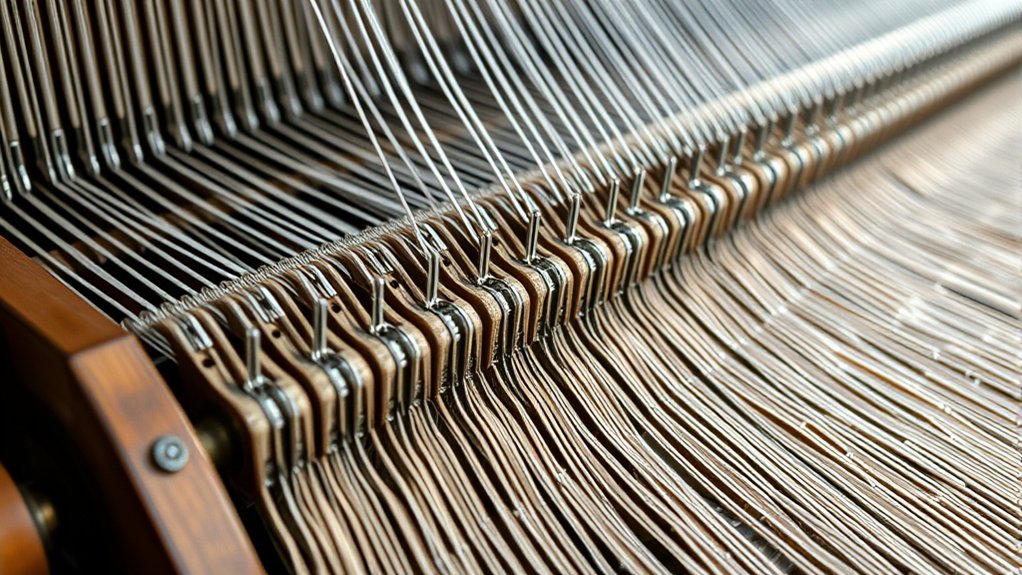
You’ll notice that the Jacquard mechanism uses punch cards to encode weaving patterns right into the loom. It’s pretty clever because this system automates the selection of warp threads. So, instead of doing everything by hand, it allows for complex designs to be created without any manual intervention. When you understand how this works, it really shows how innovation made intricate textile production a whole lot simpler.
Punch Card Pattern Encoding
When you insert punch cards into the Jacquard loom, each card directs specific hooks to lift or stay down, controlling which threads are raised during weaving. This system transformed textile innovation by enabling precise pattern encoding, allowing complex designs to be woven automatically.
Each hole in a punch card corresponds to a hook position. Holes mean the hook lifts, raising the thread; absence keeps it down. By sequencing multiple cards, you create intricate patterns without manual intervention.
This method changed weaving from a manual, error-prone task into a repeatable, programmable process. You can think of punch cards as the loom’s instructions, encoding patterns clearly and efficiently. This breakthrough laid the foundation for later developments in automated textile manufacturing and early computing concepts.
Automated Warp Thread Selection
Although punch cards encode the pattern, the Jacquard mechanism automates which warp threads lift during weaving, controlling the fabric’s design with remarkable precision. When you operate the loom, the mechanism reads each punched card, raising specific hooks that select warp threads accordingly.
This automated thread selection lets you create complex patterns without manual intervention. To keep this process smooth, you need to monitor thread tension constantly; uneven tension can cause misalignment or breakage.
Regular loom maintenance is essential, too. Lubricating moving parts and checking hook alignment ensures the mechanism responds accurately to the punch cards. By managing thread tension and performing timely maintenance, you help the Jacquard loom uphold its precision, enabling intricate woven designs that were once impossible to produce by hand.
Why Punched Cards Were Key to the Jacquard Loom
Because the Jacquard loom relied on intricate patterns, punched cards played a crucial role in its operation. These cards served as the loom’s control system, storing the instructions needed to weave complex designs. You can think of punched cards as early data storage devices, where holes represented specific commands for the loom’s needles.
By using punched cards, the loom could perform pattern encoding, translating detailed designs into sequences the machine understood. This method allowed you to automate the weaving process accurately, eliminating manual errors and speeding production. Each card corresponded to a row in the fabric, and the presence or absence of holes dictated which warp threads lifted or stayed down.
Without punched cards, managing complex patterns would be nearly impossible, as you’d have to control every thread by hand. The cards transformed weaving from a manual craft into a programmable process, laying the groundwork for future developments in automation and computing.
Beautiful Designs the Jacquard Loom Made Possible
How did the Jacquard loom transform textile patterns? It gave you the power to create intricate and beautiful designs that were previously impossible. By automating pattern control with punched cards, you could achieve precise thread tension, ensuring each thread held just right for a flawless weave. This precision made complex designs sharp and consistent.
The loom also enhanced color blending, allowing you to combine different colored threads seamlessly. This blending created vibrant, detailed patterns with smooth transitions, which added depth and richness to fabrics. You could experiment with multiple colors without worrying about manual errors disrupting the design.
Thanks to the Jacquard loom’s control over thread tension and color blending, you now create textiles with unprecedented artistic detail and complexity. This invention didn’t just speed up production; it expanded creative possibilities, letting you craft textiles that are both functional and visually stunning.
Comparing the Jacquard Loom to Earlier Weaving Methods
You’ll notice the Jacquard loom automated many steps that were once done by hand, which boosted both speed and efficiency. Plus, it let you create far more complex patterns than earlier methods could handle. So, let’s take a closer look at how these improvements changed weaving forever.
Manual vs. Automated Weaving
Although earlier weaving methods relied heavily on manual labor, the Jacquard loom introduced a groundbreaking shift toward automation. You’ll notice that this change greatly improved textile aesthetics by enabling more consistent patterns. Plus, automated weaving reduced the time spent on loom maintenance since fewer manual adjustments were needed.
Here’s a quick comparison to help you see the differences:
| Aspect | Manual Weaving | Jacquard Loom Automation |
|---|---|---|
| Labor Intensity | High, requires skilled hands | Lower, machine-driven process |
| Textile Aesthetics | Variable, depends on weaver | Consistent, intricate patterns |
| Loom Maintenance | Frequent adjustments needed | Less frequent due to automation |
You’ll find that automation streamlined weaving, making textile production more efficient and reliable.
Pattern Complexity Capabilities
When you compare earlier weaving methods to the Jacquard loom, the difference in pattern complexity becomes strikingly clear. Earlier techniques limited you to simpler designs because controlling individual threads by hand restricted intricate detail.
The Jacquard loom, however, lets you manipulate each warp thread independently, unlocking far more elaborate patterns. This capability enhances how fiber texture appears, allowing subtle variations that were nearly impossible before.
You can also achieve sophisticated color blending, weaving multiple hues seamlessly to create gradients and detailed motifs. This precision transforms fabric design, giving you creative freedom unmatched by manual looms.
The Jacquard loom’s pattern complexity capabilities revolutionized textile art, making intricate designs accessible and consistent without sacrificing the delicate interplay of fiber texture and color blending.
Efficiency and Production Speed
The Jacquard loom’s ability to create complex patterns also speeds up the weaving process in ways earlier methods couldn’t match. When you use a Jacquard loom, the programmed control of each thread guarantees consistent thread tension, which directly improves fabric durability.
Unlike manual looms where uneven tension could weaken the fabric, this machine maintains precision throughout production. You’ll find that the automation reduces errors and rework, letting you produce intricate textiles faster and more reliably.
Earlier weaving methods demanded more time and skill to manage patterns and tension by hand, slowing the process considerably. With the Jacquard loom, you streamline weaving operations, boosting both efficiency and output speed while enhancing the final product’s strength and quality.
This innovation truly transformed textile manufacturing.
How the Jacquard Loom Transformed Textile Manufacturing
Since the Jacquard loom automated complex pattern weaving, it transformed textile manufacturing by drastically increasing speed and accuracy. You’ll notice how this textile innovation simplified creating intricate designs, removing much of the manual labor previously required.
Its advanced mechanical design allowed for precision and repeatability, making large-scale production feasible. This efficiency revolutionized the industry, reducing costs and boosting output without sacrificing quality.
Here’s a quick comparison to show you the impact:
| Feature | Before Jacquard Loom | After Jacquard Loom |
|---|---|---|
| Pattern Complexity | Limited by manual skill | Complex and automated |
| Production Speed | Slow and labor-intensive | Rapid and continuous |
| Accuracy | Prone to human error | Highly precise |
| Labor Requirement | Many skilled workers needed | Fewer operators required |
| Cost Efficiency | Higher production costs | Lower production costs |
You can see how the Jacquard loom’s mechanical design marked a pivotal textile innovation.
The Jacquard Loom’s Influence Beyond Textiles and Into Early Computing
You’ve seen how the Jacquard loom transformed textile production by automating complex patterns. Its influence didn’t stop at textile patterns; it left a significant historical impact that reached early computing. The loom’s use of punched cards to control weaving inspired the concept of programmable machines.
When you look at the evolution of computers, you’ll find the Jacquard loom as a foundational reference.
Here’s why it matters beyond textiles:
- Punched cards introduced data storage and instructions.
- Pattern automation hinted at conditional processing.
- It influenced inventors like Charles Babbage and Ada Lovelace.
- The idea of machine-readable input began with the loom.
Understanding this historical impact helps you appreciate how innovations in one field can spark transformations in another. The Jacquard loom bridged craftsmanship and computation, marking a pivotal point in technological progress.
Challenges and Limitations of the Jacquard Loom
Although the Jacquard loom transformed weaving, it came with challenges that limited its accessibility and efficiency. You’ll find that technological constraints of the early 19th century meant the loom’s punched card system was complex and costly to produce. This complexity made it difficult for many weavers to adopt the technology quickly.
Mechanical reliability was another major issue. The intricate mechanisms were prone to jamming and required constant maintenance, which slowed down production. If you worked with the loom, you’d notice that any small error in card punching could disrupt the entire pattern, demanding careful attention.
Furthermore, the loom’s size and weight made it less practical for smaller workshops. These limitations meant that while the Jacquard loom was a turning point, it wasn’t immediately accessible to all textile producers. You’d need patience and skill to manage its challenges before fully benefiting from its innovative design.
Why the Jacquard Loom Inspires Modern Automation Today
Despite its early challenges, the Jacquard loom laid the groundwork for the automation we see in industries today. When you look at modern manufacturing, you’ll notice how the loom’s principles of automation still resonate.
The Jacquard loom set the foundation for the automation principles driving modern manufacturing today.
It introduced the concept of programmable control by using punched cards, enabling machines to execute complex tasks without manual intervention. This idea transformed how you approach production, especially in textiles.
The Jacquard loom’s innovations inspire automation by:
- Allowing precise control over color blending to produce intricate patterns
- Enhancing textile texture consistency through repeatable automated processes
- Demonstrating the efficiency of programmable instructions in manufacturing
- Paving the way for computer-controlled machinery beyond textiles
Frequently Asked Questions
Where Can I See a Working Jacquard Loom Today?
You can see a working Jacquard loom at museums like the Musée des Arts et Métiers in Paris or the Textile Museum in Lowell, Massachusetts. These places highlight its historical significance and technological impact on weaving and computing.
Watching it in action helps you appreciate how it transformed textile production by automating pattern weaving. It influenced both industrial technology and early programming concepts. Don’t miss the chance to experience this groundbreaking invention firsthand!
How Much Did the Original Jacquard Loom Cost to Build?
Wondering how much the original Jacquard loom cost to build? It was quite an investment for its time, around 10,000 francs, a hefty sum reflecting its groundbreaking technological innovation.
This expense paid off by transforming textile production, marking a significant historical impact. You’ll see that this loom wasn’t just a machine; it was a leap forward that shaped industrial manufacturing.
What Types of Fabrics Were Most Commonly Woven With the Jacquard Loom?
You’ll find that the Jacquard loom most commonly weaves intricate textile patterns on fabrics like silk, brocade, and damask. These materials benefit from the loom’s advanced weaving techniques, allowing for highly detailed, complex designs that were previously hard to achieve.
If you want to investigate weaving, the Jacquard loom lets you create rich, textured fabrics perfect for luxury garments and upholstery, thanks to its precise control over each thread in the pattern.
Are There Modern Digital Versions of the Jacquard Loom?
Yes, you’ll find modern digital versions of the Jacquard loom that use digital integration to control weaving patterns precisely. These looms combine traditional weaving techniques with automation advancements, making complex designs faster and more efficient.
Did Jacquard Face Legal Issues Over His Invention?
Jacquard didn’t face major patent disputes or legal challenges himself over his invention. While his loom transformed weaving, the patent system back then was less strict, and others quickly copied or improved his design.
You’ll find that although he earned fame, Jacquard’s main struggles were more about perfecting the technology and gaining acceptance rather than fighting legal battles over intellectual property rights.
Conclusion
Just like Da Vinci’s inventions sparked new ways of seeing the world, the Jacquard loom transforms how you understand automation and creativity. By mastering its punched cards and intricate patterns, you’re not just weaving fabric—you’re threading history, technology, and art into one seamless design.
So, as you delve into the loom’s legacy, remember that every innovation starts with a simple idea that can shape the future in ways you never imagined. Understanding the Jacquard loom invention opens the door to appreciating how technology and creativity intertwine to change the world.